-->

Children learn through play. As an occupational therapist who works with children and youth, I use games and toys almost every day to help develop important cognitive, visual perceptual, motor, sensory, social, play and leisure skills. While many different types of activities can be used in therapy, this blog focuses on off-the-shelf games and toys that are accessible to most. Whether you are a therapist, parent, teacher, or a game lover like me, I hope you discover something useful while you are here. Learn a different way to play a game you already own or discover a new game for your next family game night. Either way, just go play. It's good for you!

The OT Magazine named The Playful Otter one of the Top 5 Pediatric OT Blogs.


Jun 8, 2017

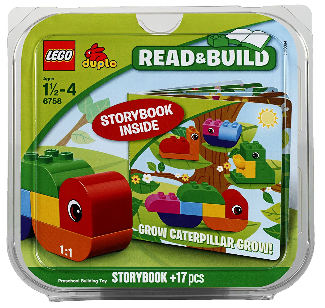
DUPLO Grow Caterpillar Grow - Read & Build


A DUPLO construction set and matching board book.


In the box: Storybook, 17 DUPLO pieces

DUPLOs and LEGOs are two of my all-time favorite construction toys and they are both made by the same company - The LEGO Group. DUPLOs and LEGOs are interlocking bricks that can be used to construct a model, taken apart, and used to construct something totally different. The replay value makes this one of the best toy values on the market, IMHO. And when you consider the skills that can all be addressed in one activity, you can see why they are a hit with therapists also.

DUPLOs are made for toddlers - large pieces that are easy to manipulate and too large to swallow. DUPLO models typically consist of only a few pieces and are meant to be played with once the models are complete. 


The book that comes with this set tells the story of a caterpillar who starts out as a baby and wants to know what he will look like when he is grown. On each page he asks a different animal (frog, snail, beetle - see image above) if he will look like them. The book shows the different pieces necessary to build each animal and you assemble each one as you read through the book.


Something I really like about this particular set is that there are enough pieces included so that all the animals can be made at the same time, you do not have to disassemble some to put others together. Once the animals are all assembled you can act out the story or read through the book again.  

Try this:
  • Start with a few minutes of free play so that the child gets the feel of the pieces and how they snap together.
  • Put only the pieces needed for the character you are making next to the individual for an easy start.
  • Put all the pieces in a pile and ask the individual to find the pieces he needs to build each character. Turn some of the pieces upside down or on their side so the child will have to recognize them from different perspectives.
  • Demonstrate how to assemble the object while the individual watches, then take the pieces apart and ask the individual to do it.
  • Cover the layers of the animal you are building above where you are building if the individual cannot see what he should be looking at.
  • Use the term "stack". I have worked with individuals that took a long time to learn the concept of starting from the bottom and building up, so I use the word stack and that has seemed to help. That and covering the pieces above the level where you are working.
  • Take time for creative play at the end with the finished pieces.
  • Work on visual discrimination, visual closure, spatial relations/position in space, manual dexterity, hand and finger strength, coordinated use of both hands, eye-hand coordination, tactile perception, executive function, process skills, creative play, play and leisure exploration and participation
If you are interested in purchasing this item or just want more information, click on the image below.

Happy Farm

Happy Farm


Patrick and his family raise roosters and sheep on Happy Farm. Patrick's father has wanted a tractor for a long time. The neighbor is willing to part with his, but he wants two cows in exchange. To get the two cows, you must advance around the board collecting roosters and sheep and then trade them for two cows. The first person to collect enough animals to trade for two cows and then buys the tractor is the winner. 


Set up the game: Place the game board in the middle of the players. Place the animals in their appropriate fields (see image below). The animals are all wood and all stand upright. Setting up the game offers a good chance to practice in-hand manipulation skills. Stand the three exchange signs in the appropriate pastures. Each player chooses a pawn and places it on a bale of hay. Place the tractor on the game board and the die nearby.

Play the game: Players take turns throwing the die and advancing around the game board. The die show numbers 1-5 and a barn. Throw a barn and  .  Throw a number and advance that many spaces forward. The player will follow one of these instructions depending on which space he lands on:
  • One rooster - Take one rooster from the field and put it with your animals.
  • One sheep - Take one sheep from the field and put it with your animals.
  • Two roosters - Take two roosters from the field and put them with your animals.
  • Bale of hay - Make a trade if you have enough animals. If not, your turn is over.
    • Trade three roosters for one sheep
    • Trade three sheep for one cow
    • Trade two cows for one tractor - win the game!

Try this:
  • Skip using the game board. Just mix the animals all together and play a sorting game.
  • Practice in-hand manipulation as you set up the game. Place one or two animals in the players palm and ask him to bring them to his fingertips one at a time to orient and place. Or allow him to pick them up himself and do the same. Make sure the animals are lying on their sides, upside down, etc. so some manipulation will be required after it is picked up.
  • Cup the hand before shaking the die. Keep the hand in that position longer by singing a verse of Old McDonald while shaking (or substitute "Patrick's father" for the words Old McDonald).
  • Put the game away by cupping the hand(s) and dropping the animals in one at a time. Count them and see how many can be held without dropping. Put them back into the box by the handfuls.
  •  Work on visual discrimination, figure ground, eye-hand coordination, manual dexterity, in-hand manipulation, palmar arch development, process skills, simple counting, socialization skills, play and leisure exploration and participation

In the box: 1 game board, 4 pawns, 1 die, 5 cows, 15 sheep, 20 roosters, 3 animal sign boards and 3 stands

If you are interested in purchasing this game or just want more information, click on the image below.