-->

Children learn through play. As an occupational therapist who works with children and youth, I use games and toys almost every day to help develop important cognitive, visual perceptual, motor, sensory, social, play and leisure skills. While many different types of activities can be used in therapy, this blog focuses on off-the-shelf games and toys that are accessible to most. Whether you are a therapist, parent, teacher, or a game lover like me, I hope you discover something useful while you are here. Learn a different way to play a game you already own or discover a new game for your next family game night. Either way, just go play. It's good for you!

The OT Magazine named The Playful Otter one of the Top 5 Pediatric OT Blogs.


Jun 16, 2017

The Artist Who Painted a Blue Horse

The Artist Who Painted a Blue Horse - A unique coloring game.


The Artist Who Painted a Blue Horse is a coloring game, a first of its kind for me. Whether you use markers, colored pencils, or crayons, coloring is an activity that many kids like and that is great for helping develop fine motor and general hand skills. It's also a way to get a writing tool into the hands of reluctant writers. I've passed out many a color book and box of crayons in my day. Unfortunately, they are not making color books like they used to. If you go to Walmart, a color book is likely to cost you $6. The dollar store still carries them but they are called activity books, and half of the pages are devoted to puzzles, mazes, and the like. 

 
The object of The Artist Who Painted a Blue Horse, according to the box, is to "explore the painter's color palette in this cooperative game of self-expression." My ideas are quite different, but as we know, one game can work on many different skills. 

This game comes with very simple drawings of several different animals (lion, bear, fox, crocodile, horse, donkey, cow) on plain white paper. Pictures are L 5" x W 2 3/4" and each animal is divided into four sections.


LEFT - Spinner.                         RIGHT - Game Board.


The Artist Who Painted a Blue Horse also includes a spinner with a free moving arrow. I will list what each space on the spinner means in the rules below. There is also a game board with 26 spaces.

Object: 

Complete a masterpiece by coloring a picture.

Set up: 

Place the game board, spinner, and coloring implements in the middle of the table. Place a pawn on start (see board in image below).

Play: 

In turn, each player will spin the spinner. The options that may come up are as follows:

  • 1-4 - Move the pawn ahead on the board the number of spaces indicated. Everyone colors one section of his animal with the color indicated on the space.
  • Any color X 2 - The person who is spinning chooses two colors that all players will use to color a section of their animal.
  • Trade animals - Players trade their unfinished pictures and end up working on other's masterpieces.
The game ends when all sections of the animals are colored and everyone enjoys all the masterpieces.

If you would like to read more about games that require writing or drawing in some form, check out my post Games That Require a Writing Tool.  

Try this:
  • Use pencils instead of the included crayons.
  • Use your own pictures or coloring books for more variety, a longer game, and to customize the skill level or subject of interest to your individual color-er.
  • Follow the path on the game board with your eyes and touch each color as you name it. Do this before the game to familiarize yourself with the colors.
  • Tape the animals in a long line on the wall as you finish coloring them. Make a parade of animals for everyone to enjoy. A good chance to practice using a tape dispenser. Make up a story about what is happening with the animals.
  • Lay the crayons on the table upside down so that when an individual picks one up, he will have the opportunity to rotate and shift in-hand for correct placement for coloring.
  • Practice flicking the arrow with different fingers to thumb. Look for the big circle in the web space before flicking.
  • Practice distal rotation by coloring in the animals using small circular motions. I call it giving the animal "curly fur".
  • Enlarge the pictures on a copy machine if the individual cannot color precisely enough for this size. Then reduce the picture incrementally until they can.
  • Work on visual discrimination, visual closure, eye-hand coordination, fine motor precision, dynamic grasp, finger isolation, separation of two sides of the hand, coordinated use of both hands, thumb to finger, developing web space, coloring, manual dexterity, executive functioning skills, social interaction skills, process skills, play and leisure exploration and participation
In the box: Game board, spinner, 4 pawns, 144 sheets animal coloring pad, 8 crayons

If you are interested in purchasing this item or just want more information, click on the image below.


Jun 14, 2017

See-Inside Counting Tubes

See-Inside Counting Tubes - 1-10

I've never seen anything like these See-Inside Counting Tubes before. Use these tubes to learn to count from 1-10.

Each tube will hold a certain number of balls, and that number is shown at the top of each tube. Learn to count by pushing a tube down on the balls, one at a time, and counting as they snap into the tube. Once you reach the number of balls indicated at the top of the tube, no more balls will fit. The balls are about the size of marbles and are made of smooth plastic. There are 55 balls and they come in multiple colors - purple, yellow, orange, blue, and green. There are 11 of each color. That is exactly enough balls to fill the tubes, so don't lose any. These balls are plastic, not rubbery like the balls in Gumball Grab and Tweezer Tongs. They are going to roll and getting them to stay put on a flat surface is tricky. I usually take the tubes out of the box and empty the balls into the box bottom, then they can't roll away. A cookie sheet or similar flat surface would be really noisy as you push down on the plastic tube to pick up each ball. 

The box says "tap & count", but I had to do more than just tap. First I tried holding the tube like a big pencil. I didn't think it through, that is just how I picked it up, and I had to push really hard on the balls to get them to snap into the tube. After my fingers started to get tired I moved to the grasp that you see the boy using on the image above. That worked much better and the balls went in a little easier. The tubes will stand on their own like in the image above.

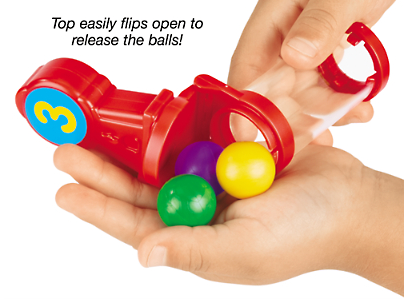
Once the balls are in the tubes the only way to get them out it to snap the tube open at the top and pour them out. It takes a little effort to open and close. Once those balls are in the tube, they aren't coming out until you're ready to take them out. Open the tops for the first time yourself before playing with the kids. Ease the top all the way back, wiggle it if you have to and loosen the hinge so the lid pulls back easily. I let a child be the first to open a couple of them and he snapped the lids back fast, bending the hinge and now the tops are loose from the tube. The lid still snaps on, but I will have to do it from now on.
Here is a picture of a child with an open tube pouring them out.


SAFETY FIRST - Make sure this game is appropriate for the person you want to play it with. Be careful around anyone needing supervision for safety because of the size of the balls and the fact that they look like gum or candy. 

The manufacturer, Lakeshore Learning, suggests ages 3+ for a typical population. They have also included several activities that you could use to teach math.

Try this:
  • Introduce the activity by using a tube and pressing in the balls, counting as you go. Model how to hold the tube to get the force you need comfortably.
  • Line the tubes up sequentially after they are all filled. 1-10, and 10-1.
  • Put the balls in a bowl. Pick out only the marbles you will need to fill one tube at a time. Squirrel them into palm as you pick them out. How many can you hold?
  • Fill each tube with only one color. For instance tubes 1 and 10 are blue, tubes 2 and 9 are green, tubes 3 and 8 are orange, etc.
  • Cup the hand and drop balls in one at a time while counting. How many can you hold. Put them back into the box by handfuls. Now use the other hand and try for one more.
  • Cup both hands, placing them side by side, while someone else drops them into your hands. Name them by color as they are dropped. Now how many can you hold? Put them away by the handfuls.
  • Fill the tubes with mixed color marbles and line them up in order from 1-10. Starting with the #1 tube, name the color of each marble in order, practice it out loud three times. Then close your eyes and say it. Look at tube #2 and memorize the order of the colors, then close your eyes and say it. Work your way up the tubes, how far can you go memorizing the color sequence?
  • Hold a tube upside down in the non-dominant hand and push the balls in with the dominant hand. 
  • Work on visual discrimination, visual memory, grasp, reach, strength, coordinated use of both hands, counting 1-10, manual dexterity, palmar arch strength and support, executive functioning skills, process skills, play and leisure exploration and participation,
  • Make pattern cards, using paper and markers, for several of the tubes. Leave the numbers off so the individual will need to count and then find the appropriate tubes. Then fill each tube with the color order of the marbles on the pattern card.