-->

Children learn through play. As an occupational therapist who works with children and youth, I use games and toys almost every day to help develop important cognitive, visual perceptual, motor, sensory, social, play and leisure skills. While many different types of activities can be used in therapy, this blog focuses on off-the-shelf games and toys that are accessible to most. Whether you are a therapist, parent, teacher, or a game lover like me, I hope you discover something useful while you are here. Learn a different way to play a game you already own or discover a new game for your next family game night. Either way, just go play. It's good for you!

The OT Magazine named The Playful Otter one of the Top 5 Pediatric OT Blogs.


Feb 27, 2019

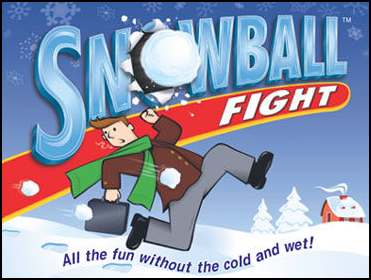
Snowball Fight Card Game


Snowball Fight Card Game - A snowball fight without the cold or snow?

All this winter I've listened to my family describe the heavy snows, the icy roads, the blowing winds and the frigid temperatures. Still a Midwesterner at heart, I miss the cold and snow and have MANY wonderful memories of building snowmen, snow furniture, snow forts, and having snowball fights. Stuck in this cool, but nowhere near frigid weather of the southwest, I have to find my snow fun elsewhere. Enter Snowball Fight Card Game, a card game that lets you lob dipsy doodles, rapid fire, and even sneak attack snowballs at your opponents. Without the frostbite or soaked mittens. (It's still not the same thing, but it runs a close second).

This is a card game that consists of 22 different cards (170 total). There are 10 different offensive snowball attack cards and 7 defensive cards (there are multiple cards of each particular card). Each card is assigned a score. The overall goal is to keep your score as low as possible. 

Taking turns, one player will choose one opponent and play an offensive snowball card against them. Then they will throw the die and that number will be the amount of points that will be added to the score of the person attacked. However, the player who is attacked is allowed to play a card in their defense, if they have one, which may reduce the amount of points held against them. A defending card may even give the attacked a chance to throw the die and force points on the attacker. The different cards that are played are worth different points and unless you play this game A LOT, you will probably have to play with the score card by your side. Here is a picture of it.
 
LEFT: Offensive shots.   RIGHT: Defensive shots.

 Object:
Be the last person to accumulate 30 points.

Set up:
Shuffle the cards. Deal six cards to each player. Put the remainder of the cards in a face-down pile on the table.

Play:
The first player announces the person they want to attack, they plays an offensive card against them, and then they throw the die to see if their snowball hits the defending player. Now these three things must happen in this order (and I quote):
  1. Reduce the attack roll(s) as instructed by the defending player's defensive card. Example: Subtract 2 from Attack Roll reduces die roll of a 5 to a 3. 
  2. If the reduced die roll still falls into the offensive card's hit range (indicated on each card at the bottom), the defending player has been hit with a snowball! Add the points noted on the card to the defender's total score. If it does not fall into this range, it is a miss and no one takes points.
  3. If Bad Aim, Powder Ball, or Catch has been played by the defending player, that player just happened to have a snowball in their hand and attacks you back. When the defender plays this Return Attack card, he is allowed to roll the die. If it comes up five or six, the attacker now becomes the victim and must take 2 points. The attacker is not allowed to defend himself (unlike a REAL snowball fight). 
The turn is over and each player that played a card will pick one from the deck. Continue playing, eliminating players as they reach 30 points. Game ends when all but one person has been eliminated. They are the winner.

It seems a little complicated, but it is just a matter of playing a snowball attack card and throwing the die, then playing a defensive card, and then using the number on the die with the number on the card to determine the score.

Try this:
Work on following directions, keeping score, strategy, manual dexterity, problem solving, shuffling/dealing/holding/fanning cards, process skills, executive function skills, socialization skills, play and leisure exploration and participation

In the box: 1 6-sided die, 170 cards, card description sheet


Egg Relay Race

Egg Relay Race - Lots of ways to play.

Already familiar to many people is the Egg Relay Game. Often this is played with large kitchen spoons and real eggs (boiled or otherwise). It's fun because it can be played inside or outside, many ways, in most any location.

These spoons are lightweight, hollow plastic. They measure 7 1/2" long by 2 3/16" at the widest place (bowl of spoon). The bowl of the spoon is not very deep, but it has an edge around it so that the eggs won't just roll off. The end of the handle gets wider toward the bottom so there is something to grasp and so the spoon won't twist or turn in your hand.

The eggs are hollow plastic, open like the typical plastic Easter eggs you see this time of year and come in the same five different colors as the spoons - purple, red, green, yellow and blue. There are 5 small, squishy, spikey balls that are also color coordinated. They don't seem to have any real purpose other than riding along in the egg. I suppose you could use them as a prizes if you didn't mind giving them away.

There are a lot of different egg relay games for sale. I think this one may be a good one for beginners because of the wider handle and the edge around the bowl that helps keep the egg in place.
 
Each egg has a small matching color spikey ball.

Object:
Be the first player to the finish line with the egg on the spoon.

Set up:
Place a squishy ball in each egg. Line up 2 -5 kids, each holding one spoon with one egg balanced in it. Determine where the finish line will be.

Play:
On go, all players walk as quickly as they can toward the finish line, being careful not to drop the egg off the spoon. If the player drops the egg, he must pick it up and go back to the starting line and start over. First player to the finish line wins.

Try this:
  • Work on visual discrimination, visual closure, eye-hand coordination, manual dexterity, balance, shoulder stability, coordinated use of two hands, tool use, motor planning, socialization skills, executive functioning skills, process skills, play and leisure exploration and participation  
  • Play with only one person. Walk one egg at a time to a container on the other side of the room.
  • Place small prizes in the eggs. Let one person win per game, or let each person open his egg once he gets to the finish line.
  • Put the eggs in a bowl and try scooping them onto the spoon instead of placing it there with your fingers. 
  • Put the eggs in a bowl and tell the player the color of egg to scoop up and walk across each time. 
  • Hide the eggs around the room and collect them with the spoon. The eggs will need to be close to something they can stop against so you can bump the egg up against it while pushing the spoon under it. This spoon is too thick to angle and push it under the egg in open space. The egg just rolls.
  • Hide the eggs around the room, making sure only part of the egg is exposed to view. Go on an egg hunt.
  • Allow the individual to fill the eggs before playing. A good two handed activity.
  • Fill a pan with mini marshmallows. Open an egg and, using one in each hand, scoop them together and see how many marshmallows you can pick up. Go again and try for more. 
  • Hide the eggs around a room or outside. Use other eggs you may have so there are more to find. Find an egg and run it back to your basket. Set a time limit and see who can find the most.
  • Hide a number of your own eggs around the room. Assign the person one color. Ask them to find all the eggs of that color. Tell them in advance how many there are so they know will know when they have found them all.
  • Make an obstacle course by putting furniture or other items in the path of the individual that they will have to walk around to get to the finish line.
  • Use your imagination and carry other things on the spoon.
  • Stack and carry marshmallows on the spoon. How many can you get to the finish line safely. The higher you stack, the more chance they will fall. Should you go safe and low, or tall and take a risk losing them all? Get one point for each marshmallow that makes it. Person with the highest score after several rounds is the winner.
  • Dye Easter eggs before or after playing the game.
In the box: 5 plastic spoons, 5 plastic eggs, 5 spikey balls