
 |
| Fish-A-Ree - Catch and match measuring game. |
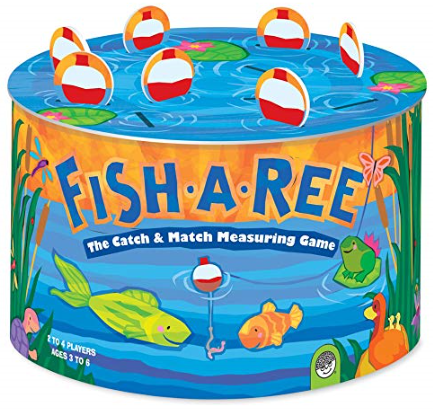
Fish-A-Ree is a measuring game, good for someone who is learning to use a ruler. I'll say upfront that the box is much bigger than the contents. I opened the box and saw the pieces lying in the bottom and thought this can't possibly be all there is to it. But yes, it was. The box has to be deep because those fishing bobbers that you see in the image above, floating above the water, are actually different lengths.
The Fish-A-Ree game box is 9" in diameter and 6 1/8" deep. It has a simple rope for a handle that is not pictured above. There is a separate round piece that sits on the top of the box (see image above) that has 12 slits in it. The bobbers that you see in the image above are just above the fish. This is how the game will look after it has been set up for play (image above).
There are 12 bobbers, 10 with fish and 2 with boots. Those pieces look like this:

Each fish will measure anywhere from one to six inches in length. There is a ruler that measures an actual 10 inches.
The number cards each show one number between two and 10.
Object:
Collect the most number cards by catching pairs of fish that measure up to the numbers on the cards.
Set up:
Unfold the pond board and place it on top of the box (pond). Randomly place the fish and boots into the slots. Rotate the pond board in case anyone remembers where the pieces are. Shuffle the cards and place them in a face-down pile nearby. Place the ruler next to the pond.
Play:
Players take turns. On your turn, turn over the card on the top of the deck so all can see the number. Pull one bobber out of the pond and follow these directions:
- Boot - If you get a boot, your turn is over. Return it to the pond and place it in the same hole it came out of. Put the card on the bottom of the deck.
- Fish - If you get a fish, place the fish (and not the bobber) next to the rule to see how long it is (see image above).
- If your fish is the exact number of inches long as the number on the card, you win the card. Take the card and put the fish back exactly where you got it.
- If the fish is too long, for instance your card says 2 and your fish is 7, it is too long. Your turn is over. Put the card on the bottom of the deck and return the fish to the pond, putting it in the same spot where you got it.
- If the fish is too short, decide what size the next fish needs to be to equal the number on your card. For instance, your card says 7 and you draw a fish that is 2 inches long. You will need to choose a fish that is 5 inches long (adding 2 and 5 will equal 7). Choose another fish and place it tail to tail next to the fish that is already lined up by the ruler. If it is exactly the number you need, take the card. Put the two fish back into the pond exactly where you found them. If the number does not match, put both fish back into the pond, exactly where you found them, and place the card on the bottom of the deck. Your turn is over.
Remind the players to watch and remember where fish are located as they're pulled out and then replaced. That way you can quickly find the number you need on your turn and avoid the boot.
Try this:
- Talk about the ruler and bobber sticks (fish) before playing. Show how the fish are divided into sections and how to measure them against the ruler.
- Measure different things that you have around the house after playing the game. Look in advance so that you have items ready that measure exactly to the inch.
- Introduce a real ruler after you play. Talk about the 12 inches vs 10 inches, how it is called a foot, how the inches are broken down into smaller units, etc. Walk around and measure things with the real ruler.
- Play a simple match game. Skip the ruler and the number cards. Randomly place the fish in the pond. Taking turns, each player pulls out two fish. If they match, keep them. If they don't, put them back in the exact same spot where you found them. Two boots make a match. Play until all 12 sticks have been claimed. Winner is the person with the most sticks.
- Hide a prize in the box and set the game up before the player comes to the table. Play the game, then let the winner lift the top off and reveal his prize. Small bags of goldfish crackers or Swedish fish would be fun. Or have several small baggies of a variety of goldfish flavors and let each player choose his favorite.
- Talk about the basics of fishing, what a bobber is for, why there is a boot in the game, the different types of fish people catch, etc.
- Make sure the player does not turn the box before returning each fish. Everyone needs to remember where the fish are in relation to where they are sitting, plus it will require that the player angle their hand/fingers differently for different slot angles.
- Work
on measuring, visual discrimination, visual memory, spatial relations,
eye-hand coordination, manual dexterity, mental math, process skills,
socialization skills, play and leisure exploration and participation
In the box: 12 fish and boots (bobber sticks), 1 pond board, 24 number cards, 1 ruler
If you are interested in purchasing the game or just want more information, click on the image below.


