-->

Children learn through play. As an occupational therapist who works with children and youth, I use games and toys almost every day to help develop important cognitive, visual perceptual, motor, sensory, social, play and leisure skills. While many different types of activities can be used in therapy, this blog focuses on off-the-shelf games and toys that are accessible to most. Whether you are a therapist, parent, teacher, or a game lover like me, I hope you discover something useful while you are here. Learn a different way to play a game you already own or discover a new game for your next family game night. Either way, just go play. It's good for you!

The OT Magazine named The Playful Otter one of the Top 5 Pediatric OT Blogs.


Nov 4, 2019

Oops!

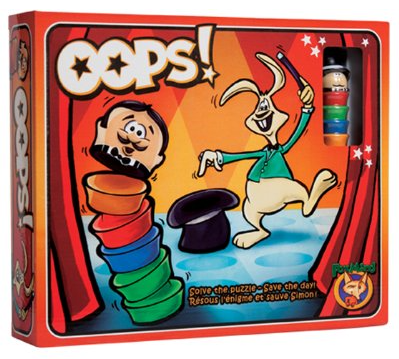
Oops! - Help the magician "get himself together" in these 50 challenges.
Oops! is a one-person logic, strategy game by MindFox. Simon is the magician and he accidentally divides himself into several pieces and then needs your help to reassemble himself. Kind of a goofy premise, but you get the picture.

The playing board is also the storage box. The back of the lid is white and has indented round spaces where the pieces will stand. Set up the pieces according to a challenge from the puzzle book, then follow the rules to move the pieces on the board so the stack always ends up sitting in the hat.


The game pieces are all hard plastic. There is a box with cover/game board, a head piece, 7 body pieces, and a hat piece. You will be moving stacks of pieces, picking up more and more pieces as you go. The pieces are smooth plastic and are made to stack. However, they don't snap in place or fit snugly together and I found myself dropping them from time to time as I moved the stacks around. With practice it got better.

The puzzle book is an easel-type book that is spiral bound, so it stands up nicely. Turn the book around to see the solution if you get stuck (if you make it to the hat, you already know the solution:). The 50 puzzles are divided into four categories for difficulty and get harder as you go. Here are puzzles 1 and 50 with the solutions:

Left - puzzle.  Right - solution.


If you would like to read more about one-person logic puzzles, check out my post What's in Your Therapy Box? Logic Puzzles Edition


Object:
Get all the pieces stacked on top of the hat. 

Set up:
Choose a puzzle from the book and place the pieces on the board in the same positions.

Play:
There are several rules for play. They are:
  • Pieces and stacks move horizontally and vertically, never, diagonally.
  • A single pieces moves one step, while a stack will move several spaces, one step for each piece in the stack (4 pieces = 4 steps). Movement must always end on top of another piece, never on an empty space.
  • When moving stacks, changes in direction are allowed, but you must take the shortest route to your destination.
  • A stack may not move through or jump over another piece, you must detour around it.
  • Once stacked, pieces must remain stacked and must always move together.
  • The head must always be on top. The hat will always be on the bottom, the last space you move to. The hat never moves.
Try this:
  • Play a game as the individual watches. Problem solve out loud as you go so that they can learn the strategy. Then take it apart and let them set it up and play as you watch.
  • Take your time. If you mess up, start over. Only one puzzle requires eight steps, the other only take between five and seven steps.
  • Give minimal clues, letting them solve as much as possible on their own.
  • Work a puzzle and do all moves except the last, and let the individual do the last move. Then work another and do all but the last two, then three, etc. until the individual is working them alone.
  • Work on visual discrimination, eye-hand coordination, spatial relations, logic, problem solving, manual dexterity, process skills, executive functioning skills, play and leisure exploration and participation.
If you are interested in purchasing this game or just want more information, click on the image below.


Oct 30, 2019

Blurble

Blurble - Be the first to blurt.
You're going to have to think fast to play Blurble. Everything included in the Blurble game is shown above - cards. You are looking at the back of the cards, and the front of each card shows a simple object. Here is an example:
As cards are flipped, be the first person to blurt out a word that begins with the same letter as the object on the card. Proper nouns, numbers and words with less than three letters are not allowed. Make it even more difficult by adding that no words that include part of the object name can be used. For instance words like snowflake, snowstorm or snowbank could not be used for snowman. That's it.

Object:
Be the person with the most cards at the end of the game.

Set up:
Shuffle the cards. Choose a Blurber (person who will flip the cards).

Play:
The Blurber and the person to their left start the game. The Blurber turns over the first card and both players race to see who is the first to say a word that starts with that letter. The winner takes the card. If the Blurber is the winner, then he faces-off with the next player and continues to change players for each card until he loses. At that point, the person who won is not the new Blurber and starts by playing a face-off with the person to their left. Repeat until the game is over and then each person counts their cards to determine the winner. To end a game either 1) play a certain amount of time OR 2) play until someone has won a predetermined number of cards OR 3) grab a stack of cards and play until they are gone.

Try this:
  • Play with two people and let the same person be the card-flipper. Pick each card off the deck without sliding others off or toppling the pile.
  • Play with several people and let one person be the Blurber, holding a small stack of cards in the non-dominant hand and pushing them off the top one at a time with the thumb. It may be more difficult to determine a winner if several people speak out at the same time.
  • Name a word that begins with the last letter of the object on the card, instead of the first.
  • Make up your own game. Lay two cards side-by-side and see who can be the first to come up with something they both have in common. For instance a watermelon and a vacuum both roll.
  • Lay a bunch of cards face-up in a grid on the table. Take turns naming a category and taking off all the cards in that category. Winner is the person with the most cards at the end of the game.
In the box: 500 cards

If you are interested in purchasing this item or just want more information, click on the image below.