-->

Children learn through play. As an occupational therapist who works with children and youth, I use games and toys almost every day to help develop important cognitive, visual perceptual, motor, sensory, social, play and leisure skills. While many different types of activities can be used in therapy, this blog focuses on off-the-shelf games and toys that are accessible to most. Whether you are a therapist, parent, teacher, or a game lover like me, I hope you discover something useful while you are here. Learn a different way to play a game you already own or discover a new game for your next family game night. Either way, just go play. It's good for you!

The OT Magazine named The Playful Otter one of the Top 5 Pediatric OT Blogs.


Dec 6, 2019

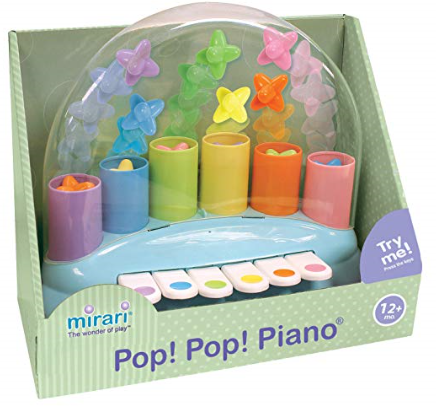
Pop! Pop! Piano

Pop! Pop! Piano -Jumping, popping musical stars!

Pop! Pop! Piano is a simple to use, color-coded musical toy. There are six colored tubes, six stars of matching colors and six keys to push with the same six colors. You can see the stars in the image above. These stars are not printed on the clear plastic, as it may appear. This is just their way of showing you that the stars will jump up and over when you hit a key. Everything is self-contained and the unit cannot be opened without breaking it.

Shake the piano so that the stars are mixed up and land back into the tubes.
Press the key with a specific color and if there is a star in that tube it will jump up and out. It may fall back into the same tube or it may fly to the side. The plastic is curved around the tubes, front and back, so the stars cannot jump to the back or front of the tubes, just above or sideways. 

If the star color does not match the tube color, your job will be to remove the star in the tube and get the correct star (of the same color) into the tube. This is fairly easy for an adult, so well-doable. If two stars land in a tube, grade the pressure as you push so that only one jumps out (unless you want both of them to jump out, then push the key a little harder). The keys are very easy to push down.

Now the piano part - You can turn it on and hear a note play each time you hit a key, or you can leave it off for no music. The six notes go up step-wise, just short of an octave. You can play simple tunes that only take six notes or less. For instance, I played Mary Had a Little Lamb, Jingle Bells, Do You Know the Muffin Man and Twinkle Twinkle Little Star (the ABC song) on just those six keys.

Takes 3 AA batteries. 

Try this:
  • Use index cards and colored markers to "write" out songs for kids to play. For instance you would make the colored circles green, blue, purple, blue, green, green, green for Mary Had a Little Lamb. Make the circles in short lines, from left to right, to help train the eyes for reading. Only show one line at a time on the card if the individual does not know where to start or how to proceed on a busy card.
  • Play a song without worrying where the stars fly.
  • Turn it upside down so the stars fall out. Tip it right side up and put one star in each tube. How many can you get into the same color tubes?
  • Isolate and use different fingers to play each song.
  • Work on visual discrimination, colors, spatial relations, position in space, eye-hand coordination, manual dexterity, finger isolation, motor planning, process skills, executive functioning skills, play and leisure exploration and participation  
In the box: One musical unit

If you are interested in purchasing this item or just want omre information, click on the images below:


Animal Rescue Shape Sorting Truck

Animal Rescue Shape Sorting Truck - Includes seven animals and two drivers.

Kids get a chance to use their imaginations while loading the animals into the Animal Rescue Shape Sorting Truck. Creative play with toys like these allow kids the freedom to make up a different story every time they play.

Everything is wooden except the plastic wheels, which do turn so the truck can roll. The truck measures 10.5" front to back and is 6.75" tall. Holes are cut out on the sides of the truck, one for each of the seven wild animals included (see image above). There are three cut outs on each side of the truck and one on the back door. Each animal will have to be pushed in through his own hole as holes are cut specifically to the shape of each animal. You can push the animals in through the holes to load them, or you can lift the back door off the truck and put them in through the back. Replace the door to store the animals in the truck.
 
There are also two people included, a man and a woman, both dressed in safari-type outfits. These two people stand in slots in the front of the truck. The animals are painted all over but the features are printed on one side only. Three of the animals are facing right and four are facing left. They all stand independently.


Try this:
  • Reinforce colors and animal names by describing each animal as you play, such as the grey hippo or the blue elephant.
  • Line the animals up and compare them. Who's the tallest, who's the longest, who's the biggest, etc.
  • Ask open-ended questions such as where are the animals headed today or what do you think it sounds like in the truck?
  • Present one animal at a time and scan the truck to find the hole to push it through. Can you see the correct shape just using your eyes? If not, try different pushing it through different holes until you find the right one. 
  • Present each animal in a different orientation than it will need to be to push through the hole so manipulation is required.
  • Turn the animals around so that you can't see the features. Can you remember which animal is which just by the shape? Can you find the hole the animal will go through, even though you are looking at it backwards?
  • Lay out a course around the room beforehand that the truck will drive to include ample opportunity to crawl on hands and knees.
  • Partially hide the animals around the room, letting part of each animal peek out from behind something. Ask the child to push the truck around the room and find and load each animal.
  • Take the opportunity to talk about animal sounds, habitat, food, care, etc., while you play.
  • Line up the animals that are facing left. What do you think they are looking at? Line up the animals that are facing right. What are they looking at?
  • Work on visual discrimination, spatial relations, position in space, color and animal recognition, manual dexterity, creative play, crawling (to push the truck), motor planning, executive functioning skills, process skills, play and leisure exploration and participation 
In the box: 2-piece truck (body and back door), 7 animals, 2 people