-->

Children learn through play. As an occupational therapist who works with children and youth, I use games and toys almost every day to help develop important cognitive, visual perceptual, motor, sensory, social, play and leisure skills. While many different types of activities can be used in therapy, this blog focuses on off-the-shelf games and toys that are accessible to most. Whether you are a therapist, parent, teacher, or a game lover like me, I hope you discover something useful while you are here. Learn a different way to play a game you already own or discover a new game for your next family game night. Either way, just go play. It's good for you!

The OT Magazine named The Playful Otter one of the Top 5 Pediatric OT Blogs.


Dec 8, 2019

Big Time Mini Clocks

Big Time Mini Clocks - Perfect size for teaching time.
I have used Big Time Mini Clocks many times over the years. They have been my favorite by far and yet they have a major flaw - The hands quit turning in sync after awhile. 

When teaching someone how to tell time, those hands need to move together as a unit. To function correctly, as you push the minute hand all the way around the clock, the hour hand will move one number. I will use a clock a few times and then, what seems out of nowhere, it will stop working together. You can push the blue hand all the way around the clock and the red hand will stay put.

I like everything else about these clocks including:
  • The numbers are easy to read.
  • The minutes are clearly marked and under each hour number is printed the minutes number.
  • The hands and numbers are color coded - blue for minutes and red for hours.
  • The size is just right for holding and manipulating.
  • The hands move forward and backward.
  • The clocks are flat on the bottom so they are free standing, and they even come with a little leg that you insert into a hole in the back which gives it more stability/balance in standing alone. 
Even with all these positives, there is the big negative that it does not take long for the hands to quit working together. I've owned and used several of these clocks over time and it has been the same story overall.

This past summer, a therapist friend asked me if I wanted any of these as she had lots of them that had never been used. I just happened to be working with someone on time so I took two. They quickly stopped working. Out of frustration I wondered if a real clock would work. I looked around and found a large, plastic clock that was "cheap" enough so that I could take the front off (to get to the hands). I was so intent on looking for a cover that I could remove that I didn't pay that much attention to the clock face. After all, clocks can vary greatly in design, but NOT in number orientation. I grabbed this one (below) on one of my outings and took it to therapy the next week. We got quite a laugh out of it after we started our session. I still can't figure out why anyone would manufacture a clock like this.


I just found a new box of these clocks for $2. I was happy to find them, but no matter how cheap they are, I don't like using products of any kind that are plastic and will soon end up in a landfill, for who knows how long. But I've never found anything that I liked better, when it works. The clocks measure 4" in diameter, are hard plastic, and there are 6 in a box. If you read the reviews on Amazon, people love these clocks and say that they only move clockwise. Mine moves counterclockwise also, so maybe that will eliminate the problem I've described.  

If you are interested in purchasing these clocks or just want more information, click on the image below.


Dec 6, 2019

Pop! Pop! Piano

Pop! Pop! Piano -Jumping, popping musical stars!

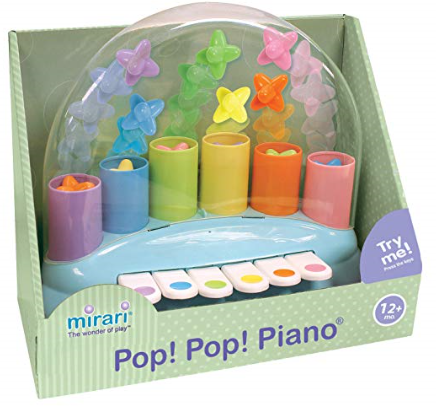
Pop! Pop! Piano is a simple to use, color-coded musical toy. There are six colored tubes, six stars of matching colors and six keys to push with the same six colors. You can see the stars in the image above. These stars are not printed on the clear plastic, as it may appear. This is just their way of showing you that the stars will jump up and over when you hit a key. Everything is self-contained and the unit cannot be opened without breaking it.

Shake the piano so that the stars are mixed up and land back into the tubes.
Press the key with a specific color and if there is a star in that tube it will jump up and out. It may fall back into the same tube or it may fly to the side. The plastic is curved around the tubes, front and back, so the stars cannot jump to the back or front of the tubes, just above or sideways. 

If the star color does not match the tube color, your job will be to remove the star in the tube and get the correct star (of the same color) into the tube. This is fairly easy for an adult, so well-doable. If two stars land in a tube, grade the pressure as you push so that only one jumps out (unless you want both of them to jump out, then push the key a little harder). The keys are very easy to push down.

Now the piano part - You can turn it on and hear a note play each time you hit a key, or you can leave it off for no music. The six notes go up step-wise, just short of an octave. You can play simple tunes that only take six notes or less. For instance, I played Mary Had a Little Lamb, Jingle Bells, Do You Know the Muffin Man and Twinkle Twinkle Little Star (the ABC song) on just those six keys.

Takes 3 AA batteries. 

Try this:
  • Use index cards and colored markers to "write" out songs for kids to play. For instance you would make the colored circles green, blue, purple, blue, green, green, green for Mary Had a Little Lamb. Make the circles in short lines, from left to right, to help train the eyes for reading. Only show one line at a time on the card if the individual does not know where to start or how to proceed on a busy card.
  • Play a song without worrying where the stars fly.
  • Turn it upside down so the stars fall out. Tip it right side up and put one star in each tube. How many can you get into the same color tubes?
  • Isolate and use different fingers to play each song.
  • Work on visual discrimination, colors, spatial relations, position in space, eye-hand coordination, manual dexterity, finger isolation, motor planning, process skills, executive functioning skills, play and leisure exploration and participation  
In the box: One musical unit

If you are interested in purchasing this item or just want omre information, click on the images below: