-->

Children learn through play. As an occupational therapist who works with children and youth, I use games and toys almost every day to help develop important cognitive, visual perceptual, motor, sensory, social, play and leisure skills. While many different types of activities can be used in therapy, this blog focuses on off-the-shelf games and toys that are accessible to most. Whether you are a therapist, parent, teacher, or a game lover like me, I hope you discover something useful while you are here. Learn a different way to play a game you already own or discover a new game for your next family game night. Either way, just go play. It's good for you!

The OT Magazine named The Playful Otter one of the Top 5 Pediatric OT Blogs.


Aug 18, 2022

Alphaprints - First Words Matching Game and Book Set


My Alphaprints First Words Matching Game and Book Set is an early-learning play set by Roger Priddy. The set includes game boards, picture cards and a sturdy, first words board book - all in a handy carry-along case. I usually don't look too much at books because I didn't use them much in therapy. However, I do have a collection of different types of books that I did use that I will put together in a future post. This box says "3 games and a book", so I took a look. Sure glad I did!

In the box are 32 cards and four game boards, all made from 1/16" thick stock which gives them some sturdiness. These items are used for the three games - bingo, go fish, and matching. The cards measure 2 1/8" x 2 3/4". The game boards measure 5 1/2" x 6 11/16" and are printed on both sides with different images. The game boards have a 2 x 2 grid, 4 squares total on each card for bingo.

Here is an image of the back of the box showing what is included.

Play 3 games - Bingo, Go Fish, and Matching.

Each card has a simple picture and one word. And as you might guess from Alphaprints in the title, each picture includes a fingerprint or two. For the bus, it is the two wheels, for most of the animals it is the body, and the faces for people. The train has a fingerprint window and smokebox door, and the wheels are orange slices.

Also incorporated into each image is an everyday item or two - a dog with balloon ears, a boat with asparagus staff and cucumber portholes, a kite with macaroni bows on the tail, a boy with lettuce hair, and a bear with a chocolate donut body. There are 16 different images and two cards for each, which makes 16 sets of two for matching games. 32 cards total.

Now let's take a look at the book.


So... the book was in perfect condition when I bought it. Does anyone else live with pups? Ours want to play constantly. Even though we have chew bones for them at all times, they still like to pick their own chew toys sometimes. We have so much fun with them that it is hard to get angry with them.

The book measures 8" x 7.25". It is a board book, meaning the pages are thicker so they are easier to turn by younger children who might have trouble separating paper pages. There are 18 pages and they are very smooth. 


There are one or more fingerprints on each page, and the fingerprints are raised print, like on some business cards. It is a cool, calming feeling to run your fingers over the smooth pages and the raised fingerprints - at least for me. Maybe it's because I'm an OT, and the whole tactile thing, but I really like it. Wish I had found this set before I retired. I'll probably be saying that a lot now. 

Try this:

  • Close your eyes and open the book anywhere. Run your fingers over the pages and stop to feel the raised print when you find the fingerprint(s).
  • Start with fewer sets for the matching game for young children. Add one extra set at a time as they can remember more.
  • Leave enough space for fingers between cards when you set up the matching game, so there is enough space to flip. Remember to leave the cards in the same place after turning them back over, or it may be a very long game.
  • Name the different items that comprise each picture. Have a sample of the real thing for each item (macaroni bows, orange slices, chocolate donut, etc.). Mix the 9 different cards and place them face up. Produce one real item, like the macaroni, and ask the individual to find the card that it appears on.
  • Repeat each word several times, out loud, as you study and feel each item.

In the box: Book, 32 cards, 4 game boards

Aug 13, 2022

Volkswagen 3D Jigsaw Puzzle - Ravensburger


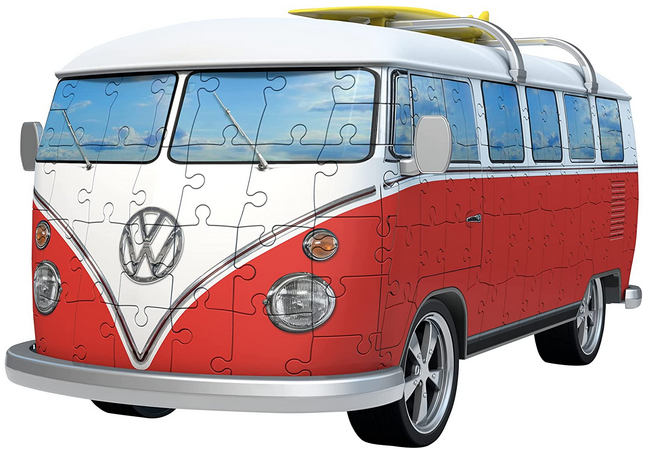
Ravensburger 3D VW Bus Jigsaw Puzzle

OK, I know that I recently made a general jigsaw puzzle page with a collection of my links and said that jigsaw puzzles wouldn't have their own, individual posts any more. But this plastic Volkswagen 3D jigsaw puzzle is just too cool not to be given a platform and discussed. 

Ravensburger, my favorite name in jigsaw puzzles, has many 3D puzzles with plastic pieces. I have several and they are all round. Never have I owned, or even seen, one shaped like a VW bus - until now. This puzzle has a chassis, rolling wheels, a hard top, and a luggage rack. Like I said, it's cool.

Looking into the box, before assembly.

There are 167 plastic pieces, colored on one side, white on the other. The pieces have tabs and blanks, just like typical jigsaw puzzles. Unlike typical puzzles, you will not be assembling the VW by the image on the colored side. The pieces are numbered from 1-167 on the back, white side. On each piece is also an arrow to tell you where to attach the next piece. You will be assembling the puzzle in number order. Let me drop in an image here so that you can better understand what I mean.


Piece number 37, bottom right, has an arrow pointing to the right. That tells you where to attach piece number 38 - on the right. Piece number 38 has an arrow pointing up. That is where you will attach piece number 39 - above number 38. It's a fairly simple process. The pieces snap together tightly enough.

To build it, I called on my husband. He likes to build and assemble things and is very good at it, as I have mentioned in several past posts. While I like assembling jigsaw puzzles, I knew this would be different. My husband noted that building it was easy, but holding the pieces together while you are building is a little tricky at times. There are four rounded corners and these are the places that it was most likely to break apart, and where he had to re-snap multiple times. This is definitely a two-handed activity with lots of hand skills involved, and not for beginners or those who frustrate easily. A typical assembly time might be 1-2 hours.

I took a picture after we were done, but this professional picture is better.

My husband suggested gluing it after he was done. I didn't because I am going to donate it to a non-profit for kids. But it would look nice on a kid's dresser or shelf.

This is the puzzle ball I used occasionally in therapy - Farm Puzzleball. I like it because it has a half-dome round frame to stabilize the puzzle on as you are building it. 

Try this:

  • Sort the pieces before you begin, to cut down on time. Since the pieces are all white, there will be nothing to help you identify quickly each piece as you need it. I sorted while my husband assembled. I sorted 1-100 first, putting them into piles by 10s. Then I did the same for the numbers above 100.
  • Pinch each piece as you put it into place, to flatten it with the rest.
  • Try putting several pieces together and then attaching that bigger piece to the model, if holding it while adding one pieces at a time is more difficult.
  • Work on sequencing numbers, spatial relations, in-hand manipulation, pinch, coordinating the use of two hands, grading pressure, process skills, play and leisure exploration and participation, maybe problem solving and frustration tolerance.

In the box: 167 pieces plus wheels, chassis, luggage rack, surf board