-->

Children learn through play. As an occupational therapist who works with children and youth, I use games and toys almost every day to help develop important cognitive, visual perceptual, motor, sensory, social, play and leisure skills. While many different types of activities can be used in therapy, this blog focuses on off-the-shelf games and toys that are accessible to most. Whether you are a therapist, parent, teacher, or a game lover like me, I hope you discover something useful while you are here. Learn a different way to play a game you already own or discover a new game for your next family game night. Either way, just go play. It's good for you!

The OT Magazine named The Playful Otter one of the Top 5 Pediatric OT Blogs.


Aug 20, 2023

K'Nex - Build A Bunch

30 models and 66 pieces in one box!


K'NEX Build a Bunch is another great construction toy from K'NEX. K'NEX pieces are made from brightly colored plastic and are well constructed. Most of the pieces are more pliable than Lego pieces, which are hard plastic. Many pieces have to be pushed in from the front/back, or top/bottom and "pinched" together. Like most construction sets, it does take some strength to snap the pieces in and out of place.

This set comes with funny features such as big googly eyes, curly tails, and wings. This is a good value, as this 66 piece set comes with ideas for making 30 different models (see image below)! Some models may need to be disassembled before making other models as they may use some of the same pieces.

A single sheet shows all 30 completed models and does not show a step-by-step process. It is harder to assemble this way than from a step-by-step guide, as you will have to determine where to start and how to proceed, and you may not be able to completely see all pieces or how they hook together.  They are not labeled or sequenced by difficulty.


This is not how all sets come, as my older K'NEX sets do have pictures in booklets instead of on a single large sheet, but still no step-by-step guides. Be creative and let your imagination run wild!

If you would like more information about construction set, read my post Building Skills With Construction Toys.

Try this:
  • Give time for free play at the beginning so that the person can examine the different shaped pieces and how they snap together.
  • Ask the individual to pick up the model when possible and hold it in one hand while adding pieces with the other hand so that both hands work together while adding pieces.
  • Hold the model in the non-dominant hand and pick up the correct piece in the dominant hand, setting up a natural opportunity to manipulate the piece in-hand for placement. 
  • Turn pieces on the table so they are not in the correct orientation. Ask the individual to pick up a piece and turn it in-hand to the correct orientation.
  • Set a piece, or only a few pieces, at a time in front of the individual to cue him which piece(s) he will be placing next. It can be difficult to look at a completed model and determine where to start and/or how to proceed. 
  • Give the beginner one piece at a time as he needs it and point to the piece on the picture to direct where he should place it. Or gives clues such as 'let's add the wheels next', or 'now it's time to add the wings'.
  • Cover the part of the model that you are not working on to reduce confusion or to direct the building sequence. 
  • Keep the unused pieces in a pile so the child will have to search for each needed piece. Turn some of the pieces upside down or half bury them under other pieces so they will look different from the picture.
  • Add a piece while the individual watches if he gets stuck. Then take the piece off, turn it so that it is not in the correct orientation, and hand it to the individual to add back on.
  • Advise the child to hold the model in the same orientation as the one in the picture to aid in orienting pieces.
  • Have fun building your own creations. Describe them, name them, talk about the different body parts and how they will get around.
  • Work on visual discrimination, visual closure, visual form constancy, figure ground, eye-hand coordination, manual dexterity, coordinated use of both hands, in-hand manipulation, finger/hand strength, motor planning, executive functioning skills, sequencing, process skills, play and leisure exploration and participation 

In the box: 66 pieces, pattern sheet
Ages 3+, 1 player

If you are interested in purchasing this set or just want more information, click on the image below.


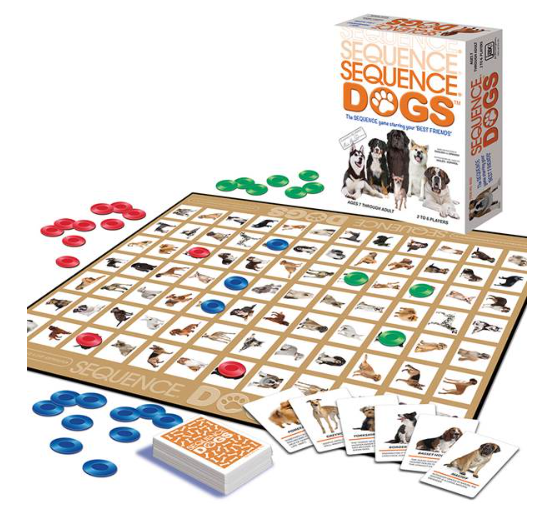
Sequence Dogs

Sequence Dogs - The dog lover's game of Sequence.

For dog fans, Sequence Dogs is a pooch-themed, 5-in-a-row strategy game. With 84 squares, each showing a single dog, the board is large. There are actually 42 different dogs as each dog appears on the board twice. If you divided the board in half horizontally, one of each dog is printed on the top half and the dogs are facing the person who sits on that side, and one of each dog is printed on the bottom half, and those dogs will be facing the person sitting on that side. In other words, the dogs on the opposite side from you will be upside down to you. There are two cards in the deck that will picture each dog, for each and every square. Each player can play anywhere on the board.

The board does not name any dog types, just shows images, but each card names the type of dog and gives some general information about the dog. There are also two fire hydrant cards and two doghouse cards. The chips are a solid color on one side and have the name of the game printed in white on the other side. 

Get 5 in a row (horizontally, vertically, diagonally) anywhere on the board to win a sequence, make 2 sequences to win the game. 

Object:
Be the first player (team) to win two sequences. 

Set Up:
Place the board on a flat surface. Give each person a bag of chips. Shuffle the cards and pass out the number indicated on the instruction sheet (depends on how many people are playing). Place the remaining cards in a face-down stack near the board.

Play:
During each turn, you will discard a card from your hand, place a chip (white side down) on the matching image on the board, draw a new card and add it to your hand. Be strategic about where you place your chips. Your goal is to get five in a row, but you must also keep an eye on your opponents and block them if they get close to a sequence. You may also play a doghouse or hydrant card as your turn. Play a doghouse card and put a chip on any empty space on the board. Play a doghouse card and remove any chip on the board (unless it is white-side-up). Once you get a sequence, announce it and turn the chips over so that the white side is up. None of these chips can be removed now. You still need one more sequence to win.


Sequence has lots of different themes including the original, states and capitals, numbers, kids, and cats.

Try this:
  • Pay close attention if you see your opponent has three in a row with empty spaces on either side. You cannot block both ends if he gets four in a row with empty spaces on both sides.
  • Hold cards in one hand and several chips in the other. Bring one chip to the fingertips to place on each turn. 
  • Skip the game. Fold the board in half so that only one of each dog is showing. Sort the cards and take out one of each dog. Mix the cards, and stack them, face-down on the table. Pick up one card and turn it face-up. Try not to disturb other cards on the stack. Everyone looks for that dog. The first person to find it first gets the card. Go through all the cards and see who collects the most. Or just play with one person and find the dogs.
  • Pick up your chips off the board, one at a time, squirreling them into your hand. How many can you hold? Put them away by the handfuls.
  • Sweep all the chips off the board and onto the table after a game. Cup one hand and put it at the edge of the table. Slide several chips into your hand. Now sort them into piles by color, bringing them one at a time to the fingertips to drop.
  • Work on visual discrimination, visual closure, visual form constancy, figure ground, manual dexterity, in-hand manipulation, shuffling/dealing/holding multiple cards, coordinated use of both hands, executive functioning skills, socialization skills, process skills, play and leisure exploration and participation
In the box: Folding game board, 150 chip (50 each of 3 different colors), 88 playing cards
If you would like to purchase this item or just want more information, click on the image below.