-->

Children learn through play. As an occupational therapist who works with children and youth, I use games and toys almost every day to help develop important cognitive, visual perceptual, motor, sensory, social, play and leisure skills. While many different types of activities can be used in therapy, this blog focuses on off-the-shelf games and toys that are accessible to most. Whether you are a therapist, parent, teacher, or a game lover like me, I hope you discover something useful while you are here. Learn a different way to play a game you already own or discover a new game for your next family game night. Either way, just go play. It's good for you!

The OT Magazine named The Playful Otter one of the Top 5 Pediatric OT Blogs.


Sep 6, 2023

Squint

Squint - Assemble the shapes to make a whole.

Squint will require you to use visualization as well as your imagination to see the parts of the whole, and the whole from the parts. And sometimes, if you squint and the object becomes a little fuzzy, it may actually come into focus sharp enough for you to see it. That sounds like a puzzle, but it's really not. The game is designed so that you will need three people, but this can easily be played 1:1 in a therapy situation.

The object of the game is to build an object so that someone else can guess what it is. The problem is that you can only use the pre-printed shape cards (white cards pictured at the top), and often you just can't find exactly what you need. Use the closest pieces you can find and when you are done building... squint. Squinting can soften images, actually pulling everything together in a way that makes it clearer.

There are 72 shape cards. There are 168 game/squint cards and each one has 6 items on it with a total of over 1,000 objects to build. Lots of replay value. The vast majority of the items are nouns (computer mouse), but there are a few verbs (cry) and some words that could be played either way (smile). Each squint card has three items on the front and three on the back. The items on each side are numbered 1-3. Example:

  • Side one
    • 1 apple, 2 paintbrush, 3 umbrella
  • Side two
    • 1 hand, 2 cup, 3 turkey

Squint also comes in a Squint Jr. version. This version shows you an image and the cards you will need to build it on each Squint card.

Object:

Be the person with the most scoring chips at the end of the game.

Set up:

Scatter the shape cards so that they are all flat and visible by all players. This is not the time to overlap them (something I often do with other game pieces to work on visual closure). Determine how many rounds you will play. One person is chosen as the builder for the round. They will pick a squint card and decide which side to use for this round. 

Play:

The builder throws the die. The number that comes up will be the number of the item that the builder will build. Turn over the timer and the game begins. As the builder builds, all players guess out loud what the item is. The builder can use as many cards as he wants and can move or animate shape cards, but cannot give any verbal clues. Once someone correctly guesses or the timer runs out, the round is over.  If no one guesses correctly, no scoring chips are given. If someone does guess correctly, that person and the builder each receive one token. Play the number of rounds that you have set out to play. When the game is over, the person with the most scoring chips is the winner.

Here are a few tips from the game maker:
  • It's OK to overlap shape cards when building.
  • Use the back (blank) side of a shape card to provide white space, or to hide unwanted lines.
  • Create related items to help players guess. For instance, identifying just a nose may be harder than identifying a nose on a face.
Try this:
  • Allow the player to choose what he wants to create instead of using the die. Putting people on the spot to create something they are not familiar with or don't know how to approach will often just create frustration.
  • Work on visual closure by making an image and leaving out one or two shape cards. Can the player identify the object with the missing pieces?
  • Play with the pieces before starting a game. Allow the player to move them around and experiment with them, coming up with his own creations spontaneously.
  • Ask the individual to shift a shape card in-hand if he picks it up in the wrong orientation for his image.
  • Start slow by choosing in a few simple objects beforehand and having two to four pieces for each one already sorted out. Suggest making one of the objects and then give the person only those few pieces needed to complete it. For instance suggest making a house and give the individual the square and the triangle. As he is successful and becomes more confident, add more shape pieces and then allow him to choose his own object to build.
  • Skip the game. Randomly deal several cards into the middle of the table. Give each player paper and pencil. Each player writes the different things they could make using one or more of the cards. End the game by each person showing the things he could make. If something is iffy, everybody vote to decide whether to accept it. Get one chip for each good idea. Person with the most chips wins.
  • Ask the player to cup their hand before shaking the die. Ask them to shake a few extra seconds to watch it "dance" and to keep the hand in the cupped position longer.
  • If the player cannot cup the hand, place a small ball in the palm and ask them to curl the fingers around it. Then remove the ball and add the die.
  • Work on visual discrimination, visual closure, visualization, visual scanning, visual form constancy, figure ground, spatial relations,  palmar arch development and strengthening, creative thinking, planning, attention, manual dexterity, timed response, in-hand manipulation, socialization skills, process skills, executive functioning skills, play and leisure exploration and participation
In the box: 72 shape cards, 168 squint cards, 80 scoring chips, squint die (1-3), timer, card tray
Ages 12+, 2-8 players

If you are interested in purchasing this item or just want more information, click on the image below.


Sep 5, 2023

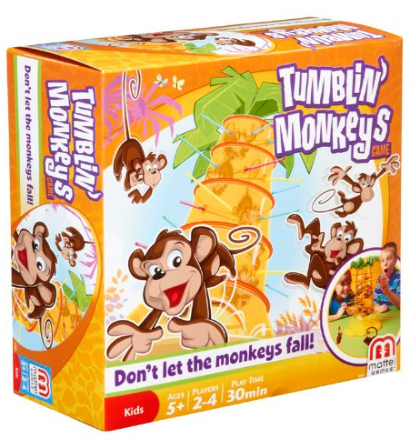
Tumblin' Monkeys

Tumblin' Monkeys - Be careful! Don't let the monkeys fall.

Pull the branches out of the tree without letting the monkeys fall! Tumblin' Monkeys is one of those games that takes as much time to set up as it does to play, but the set up is almost as fun, and can be therapeutic as well.

Before playing you will need to assemble the tree by simply snapping together the tree, the base, and the leaves topper (4 pieces total). All pieces are lightweight plastic and it is an easy set up. One at a time, push a plastic stick (branch) through a hole on one side and guide it until it comes out of a hole on the opposite side. As you insert the sticks, you will make a criss-crossed barrier inside the tree that will keep the monkeys from falling through to the bottom.

The die has three different colors on it, pink, yellow and green, one color per side. These colors match the stick colors and will dictate which stick color to remove.

Object:
End up with the least amount of fallen monkeys at the end of the game.

Set up:
Set up the tree as described above. Drop all the monkeys into the tree. The green leaves are basically a ring with a big hole in the middle where the monkeys will drop through. Monkeys will not drop to the bottom as they will be stopped by all the sticks (branches). 

Play:
Players take turns. Throw the color die and pull out one stick of that color, trying not to open up any space for monkeys to fall through. The more sticks that are pulled out, the bigger the gaps and the more chance monkeys will fall. Each player removes any monkeys that fall on his turn and keeps them in a pile next to him. When all monkeys have fallen out, each player counts his monkeys. The player with the least amount of monkeys wins. 

This game is similar to Honey Bee Tree and ToyStory Alien Freefall.

Try this:
  • To add the monkeys to the tree, pick them up one at a time and squirrel them in the palm. How many can you hold without dropping. Drop them by handfuls into the top of the tree.
  • Cup the hand to throw the die. Watch it "dance" for a few seconds before throwing to keep the hand in that position a little longer. If the player has difficulty cupping the hand, place a small ball in the hand and ask him to curl the fingers around the ball and hold his hand in that position as you remove the ball.
  • Skip the game. Place all the sticks in the tree and try to hang the monkeys on the branches that stick outside of the tree.
  • Skip the die and name the color your opponent should pull. Or just randomly pull any one branch per turn.
  • Put the monkeys away by handfuls. Ask the individual to cup a hand and drop the monkeys in one at a time as you count. Will they all fit? If not, go again cupping the opposite hand.
  • Set the tree up by throwing the die to determine the color order for inserting the branches. Place all of one color at a time.
  • Put the monkeys in a pile on the table. Use a branch and see how many you can pick up by the tail. Use this method to put the monkeys back in the box after play.
  • Play to see who can get the most monkeys. This game can end quite fast.
  • Hold a stick diagonally and see how many monkeys you can hang on it. Allow the elbow to be supported on a solid surface. Then try without the support.
  • Set up by cupping the non-dominant hand and filling it with monkeys. Then keep the hand cupped as you drop the monkeys in through the top, one at a time, using the dominant hand keeping the hand in a cupped position as long as possible.
  • See how many sticks you can pull out in one turn before a monkey falls. Keep the sticks. See who ends up with the most sticks.
  • Work on manual dexterity, pincer grasp, palmar arch development, in-hand manipulation, coordinated use of both hands, fine motor precision, eye-hand coordination, visual discrimination, spatial relations, executive functions, process skills, social interaction skills, play and leisure exploration and participation 
In the box: 4-piece plastic tree, 30 monkeys, 30 sticks in three colors (pink, yellow, green), color die

If you are interested in purchasing this game or just want more information, click on the image below.