
 |
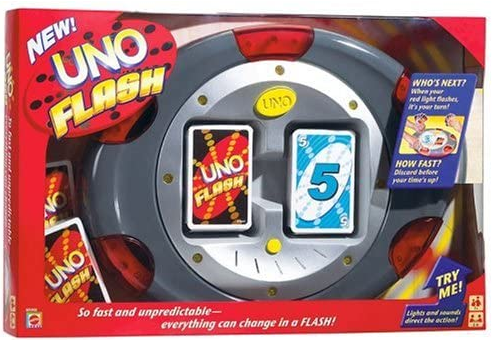
| UNO Flash - An electronic version of UNO |
UNO Flash is one of my favorite UNO games. I have at least a half dozen different UNO games that I haven't blogged about yet and was disappointed to see that several of them, including UNO Flash, can only be bought second hand now. I have found that most of the kids I work with are familiar with UNO because they play it at school. To read my post about UNO card games and the special cards included in many different themed decks, click here.
UNO Flash consists of an electronic game unit and cards. The game unit is plastic and requires 3 AA batteries. There are two switches on the bottom of the game: One turns the game on and off, the other allows you to set the speed of the game. The speeds can be set at no time limit, 6 seconds per turn and 4 seconds per turn. There is a larger slap button at the top of the tray and a smaller play/pause button at the bottom. Hold those two buttons down at the same time for 3 seconds to reset the game. The game unit is also the card tray divided into two sides: one for a draw pile and one for a discard pile.

There are six red light-up, push-able red player buttons on the game unit, enough for up to six players. Each player will be assigned to one red button near where they are sitting. You will indicate the number of players before each game begins by taking turns pushing the red button you will be using. The game unit will determine the order of play throughout the game and once a red button lights up during the game, the game unit will expect a response from that button.

The cards include most of the typical UNO cards (no reverse): Number cards, wild, draw 4, draw 2 and skip. In addition there are slap cards that picture a hand (see image above). Number cards run from 0 - 9 and there are four different number card colors, so playing can help reinforce number and color recognition. There are also instruction cards that throw twists into the game, keeping things suspenseful knowing that right as you plan to yell "UNO!" and win the game, your luck can change for the worse.
Object:
Be the first person to play all the cards in your hand to win a round. Play several rounds, earning points for the cards other players are left holding. Player to reach 500 points each wins the game. Or, just declare a winner after each game and skip the score keeping.
Set up:
Turn the game unit on and indicate the speed of play. Place the game unit between the players. Shuffle the cards and deal 7 to each player, face-down. Players hold their cards so only they can see them. Place the rest of the deck face-down on one side of the card tray, then turn the top card face-up and place it on the other side of the tray. When all players are ready to begin, players take turns pressing their red button once to let the game know which red buttons will be playing. Press the play button to start the game.
Play:
The red button will light up when it is your turn. Be ready because the unit chooses who plays randomly and you might play twice in a row or not at all for several turns. Once a red button lights up the game timer starts and the player will have to play within the time limits set before the game started. Four seconds is fast, so stay alert. Once you have played you will hit the red button to let the game unit know you are done. If you do not manage to play within the time limit a buzzer will go off. If this happens, take two cards from the draw pile as a penalty and place them in your hand.
There are different options for play on each turn, depending on what cards you are holding. Always press the red button after you are done playing. These are the options:
- Pass - Even if you have a playable card, if you don't want to play it you can choose to draw a card from the draw pile and pass.
- Play a number card - Look at the top card in the discard pile and discard a card that is either the same color or the same number.
- Slap - Play this card and then quickly hit the slap button at the top of the unit and the unit will go into slap mode. All other players quickly hit their red button. The red button will now flash for the person who was last to hit. That person must pick two cards from the draw pile and put them in their hand. Press the play button to resume normal play. This card can only be played on a card of the same color or another slap card.
- Draw 2 - Play this card and the next player must pick two cards, then his turn is over. This card can only be played on a card of the same color or another Draw 2 card in the discard pile.
- Draw 4 - This card can be played any time that you do not have a matching color to the top card on the discard pile. Play this card and the next player must draw four cards for their turn. As you play this card you will also announce the next color to be played.
- Skip - Play this card and the next player must skip their turn. They must press the red buzzer to indicate they are done with their turn. This card can only be played on a card of the same color or another skip card in the discard pile.
- Wild - You may play this card at any time and, once played, you will announce the color of the next card that is played.
Scoring:
- Number card is the value of the number on the card.
- Draw 2, skip, slap are worth 20 points each
- Draw 4 and wild are worth 50 points each
- Play with no time limits until everyone understands what is expected. Some people will always play with no time limit. Others will go from there to 6 seconds and then to 4 seconds. For a challenge, jump right into 4 second play.
- Deal by holding a small stack of cards in the non-dominant hand, pushing them off the top one at a time and taking it with the dominant hand to deal.
- Play an easier version by taking out all word cards and play with just numbers.
- Skip the game and cards. Set the unit up for six players and then quickly hit the flashing buttons as they come up.
- Skip the game. Take the wild cards out and then sort the rest of the cards into four piles by color. Hold a small stack of cards at a time in the non-dominant hand, push them off the top one at a time with the thumb and take it with the dominant hand to deal. Or start 4 piles with one color card. Place the deck near the cards. Separate and take the cards off the top, one at a time without toppling the stack, and sort into the correct color pile.
If you are interested in purchasing this game or just want more information, click on the image below.


