-->

Children learn through play. As an occupational therapist who works with children and youth, I use games and toys almost every day to help develop important cognitive, visual perceptual, motor, sensory, social, play and leisure skills. While many different types of activities can be used in therapy, this blog focuses on off-the-shelf games and toys that are accessible to most. Whether you are a therapist, parent, teacher, or a game lover like me, I hope you discover something useful while you are here. Learn a different way to play a game you already own or discover a new game for your next family game night. Either way, just go play. It's good for you!

The OT Magazine named The Playful Otter one of the Top 5 Pediatric OT Blogs.


Aug 20, 2023

Memory Games. Why are They so Popular?

Memory matching games are worth the investment.

Matching/memory games are a dime a dozen. We've all played them, I have several in my collection. I am willing to bet that you can find one for almost any theme you want. And thankful we are, as they are excellent tools for working on so many different visual perceptual skills.
  • Visual discrimination - Matching the pictures on the cards.
  • Visual memory - Remembering what the images are once the cards have been turned face-down.
  • Visual form constancy - Finding matches when the images are not exactly the same, such as one card has a picture of a fish and one has a drawing or silhouette of a fish. I SPY games are good for this.
  • Figure ground - Finding matches when the cards are all turned face-up.
  • Spatial relations - Remembering exactly where a certain card is in relation to all the cards around it.

And that doesn't even touch on the natural aspects of the game to practice other skills:
  • Crossing midline - Since the cards are set up in a big grid, you must reach across many times over before the game is done. Separate the cards this way on purpose while setting up if you don't want to leave this to chance.
  • Manual Dexterity - Since the cards are in close proximity and cannot be moved from their location (or you would never remember where to find them!), cards must be picked up where they are, not pulled to the edge of the table for help.
  • Bilateral coordination - Since many cards need to be placed face-down on the table, you have the opportunity to hold them in the non-dominant hand and deal them out and position them with the dominant hand to set up the game.
  • In-hand manipulation - As you reach for cards you will need to pick up each one and flip it in your hand, at least once, before setting it back down on the table.
  • Visual scanning - Looking across the lines of cards to find matches when all cards are turned face-up.
  • Short-term memory - Remember where and what you saw turned over on previous turns.
  • Executive Functioning Skills - You need to maintain focused attention on the cards as they are shown and then turned back over one after another. You're not going to snooze through a memory game.
Occupational therapists are trained to break tasks down into their components so that they can match each activity to the skills a particular individual is working on. It's one of my favorite parts of the job.

Here are some memory games I have blogged about. Click on the title to go to the post about that game.


What's in the Fridge? - Match food cards from the fridge to cards on your recipe.

Shopping List - Match a card to each item on your grocery list.

AARGH - Match up to 5 of a kind! Pirate-themed.

Hello Kitty Make a Match - Not just your ordinary card flipping game.

Teddy Mix & Match - 12 sets of large, colorful bears. One of my favorites.

Hello Kitty Flip 'N' Match - A unique way to play Memory that requires different hand skills.

Animal Memo - 12 sets of animals on curved wooden pieces.

Brownie Match - Use a spatula to flip brownie chunks to look on the bottom for your match.

Peanuts Matching Game - Charlie Brown themed, match 2 cards.

Flip to Win Memory Game - A wooden game with a few issues.

BBQ Blitz - Find the burger ingredients that match your pattern card.

Candy Memory - 24 sets, each a different type of candy. Some seasonal candy included.

I Never Forget a Face - 24 sets of kids faces from different cultures around the world.

Turtle Shells Memory Game - Match pattern cards to plastic turtles.

Memory Challenge Holiday - A great Christmas/winter edition with 50 sets and additional challenge cards.

Memory Challenge - Marvel Comics - A REALLY busy game with 50 sets of comic book covers. Plus added challenge cards.

Memory Challenge - Civil War - 50 sets, lots of history included, play on teams, challenge cards.

Fisher Price Go Fish - Includes fish cards, a fishing pole and boats.

Treasure Hunt - An I SPY memory game.

The Penguins of Madagascar -  Match pictures from the bottom of standing penguins.

I Scream - An ice cream themed card game. Great for a summer afternoon.

I SPY Quest - A memory game where the pictures are covered by pawns.


Aug 17, 2023

Bugzzle


Bugzzle - A buggy puzzle with 40 challenges.

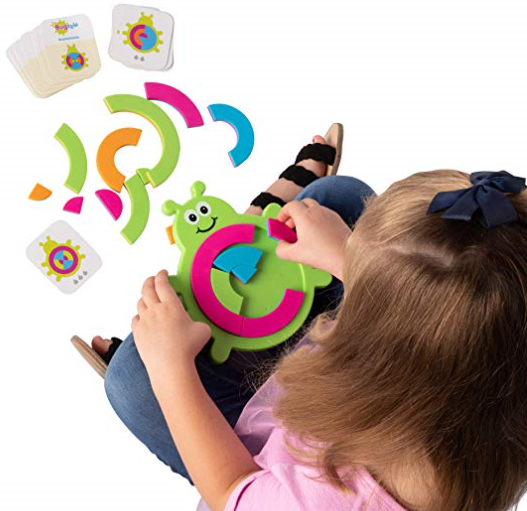
What do you get when you cross a bug with a puzzle? Bugzzle! I always thought of Fat Brain Toys as a company that sold other peoples games, but I recently realized that they design and manufacture some of their own educational and learning games and puzzles, and Bugzzle is one of those puzzles. Even though Bugzzle has a few flaws, I still like it, and so do the kids. That's half the battle right there. 

Choose a pattern card and use the curved pieces to create that pattern in the Bugzzle base.


The Bugzzle base and pieces are made of plastic. There are four different piece colors - green, orange, blue and pink - and each piece has one color on one side and another color on the flip side. The orange pieces are green on the back and the blue pieces are pink on the back. It is made of lightweight plastic but has been durable.

There will be the equivalent of two outer rings and a circle in the middle when each puzzle is complete. The puzzle cards measure 2.5" x 3" and the puzzles get more difficult as you go, each card rated in difficulty from 1 - 4. There are small grey bugs at the bottom of the cards that will show you into which level each puzzle falls (see image below). On one side of each card the pattern will show each piece with a black outline, a good place for beginners to start. The other side of the card shows the finished model with no lines around the pieces, so it will be more difficult to complete. Master the side with the outlines then flip the cards and master the side without the outlines. The number of puzzles for each level are:
  • Level 1 - 4 puzzles
  • Level 2 - 10 puzzles
  • Level 3 - 11 puzzles
  • Level 4 - 15 puzzles
Here is a sample card and its solution (side with outlines) from each level:

Front of one card from each difficulty level.

Back (solution) side of the four cards from above.

UPDATE: I was using this in therapy today with a child who was building from the solution side of the cards and I came across a couple of cards that did not work (see below). There is only one large, orange half circle and the flip side of it is green. The two cards below show a large half circle of green and one of orange. It is not doable because there are on opposite sides of the same piece. You can, however, build the puzzle if you know to use two of the quarters circles for either one of the half circles. Or, you could just take a pen and draw a line down the middle of one of the halves, so that is will be seen as two quarters. Problem solved.

UPDATE 2: I continued to use this in therapy and continued to pull out cards with patterns that were not doable. So I sat down and solved every single puzzle and came up with a total of 7 that are not doable as printed on the card. Six of them could be corrected by drawing one line to divide a piece. Here is a picture of the cards with my corrections drawn in. The bottom one could not be corrected because it shows three small blue pieces and there are only two. I have used this game a lot since correcting the flaws myself.

Cards with errors and my corrections.

For more of this type of activity, see my post on What's in Your Therapy Box? Pattern Blocks Edition.

Try this:
  • Play with the pieces before assembling the puzzle. Show how they fit together. Allow the individual to make his own design.
  • Ask the individual to assemble the puzzle from the back of the card (showing the lines around each piece), then disassemble the puzzle, turn the card over and assemble from the front. Or go through the deck assembling each puzzle from the back and then go through assembling them from the front.
  •  Work a puzzle from a card as the individual watches. Then take it apart and ask the individual to solve it.
  • Build a puzzle yourself. Give the player a few cards and ask him to find the matching pattern card. Turn the puzzle into a different orientation and see if he can find it.
  • Coach the individual to start with the outside ring if he is looking at a card and doesn't know where to begin. Then add second ring, then third.
  • Ask the individual to turn each piece in-hand as he picks them up in the incorrect orientation.
  • Place a piece as the individual watches if he gets stuck. Then take the piece out, change the orientation and hand it to the individual to place.
  • Make sure some of the pieces the individual will need are turned to the wrong color so that he can practice turning them in-hand when he picks them up.
  • Set out the pieces for each ring - outer, inner, middle - in the order that you want the individual to assemble them (outside to inside).
  • Work on visual discrimination, visual closure, spatial relations, visual form constancy, figure ground, eye-hand coordination, manual dexterity, in-hand manipulation, logic, problem solving, process skills, executive functioning skills, play and leisure exploration and participation

    In the box: Bug puzzle base, 18 plastic pieces, 40 pattern cards
If you are interested in purchasing this puzzle or just want more information, click on the image below.